Chinese Gold Panda Coinage
More Than Bullion: Four Decades of Changing Designs, Gold Weights and Collector Appeal
Few modern precious-metal coins bridge the worlds of bullion ownership and numismatic collecting as successfully as the Chinese Gold Panda.
First introduced in 1982, the Gold Panda gave international buyers another sovereign-minted way to own highly pure gold. What ultimately separated the Panda from many other bullion programs, however, was not simply its gold content. China developed a series in which the giant panda design would generally change from year to year.
That decision turned what could have been an interchangeable bullion coin into a series where year, design, weight, denomination, packaging, condition and variety can all matter.
For the investor, a Gold Panda may be a convenient unit of physical gold. For the collector, the same coin may represent a particular date, design, variety or condition rarity. Many Panda buyers eventually become a little of both.
The Beginning: The 1982 Chinese Gold Panda
The Chinese Gold Panda series debuted in 1982. The original standard program was offered in four principal gold sizes:
| Original Size | Approximate Gold Weight |
|---|---|
| 1 Troy Ounce | 31.1035 grams |
| 1/2 Troy Ounce | 15.5517 grams |
| 1/4 Troy Ounce | 7.7759 grams |
| 1/10 Troy Ounce | 3.1103 grams |
The 1/20-ounce size followed in 1983, expanding the series farther into fractional gold.
The first-year one-ounce Panda is particularly noteworthy. NGC reports an original mintage of just 13,532 pieces for the 1982 one-ounce issue. That relatively modest production helps illustrate how different the Panda market was at the beginning of the series compared with the much broader international market that eventually developed.
The Annual Panda Design Is the Difference
Most major bullion programs establish a recognizable design and retain it for long periods. The Panda developed a very different personality.
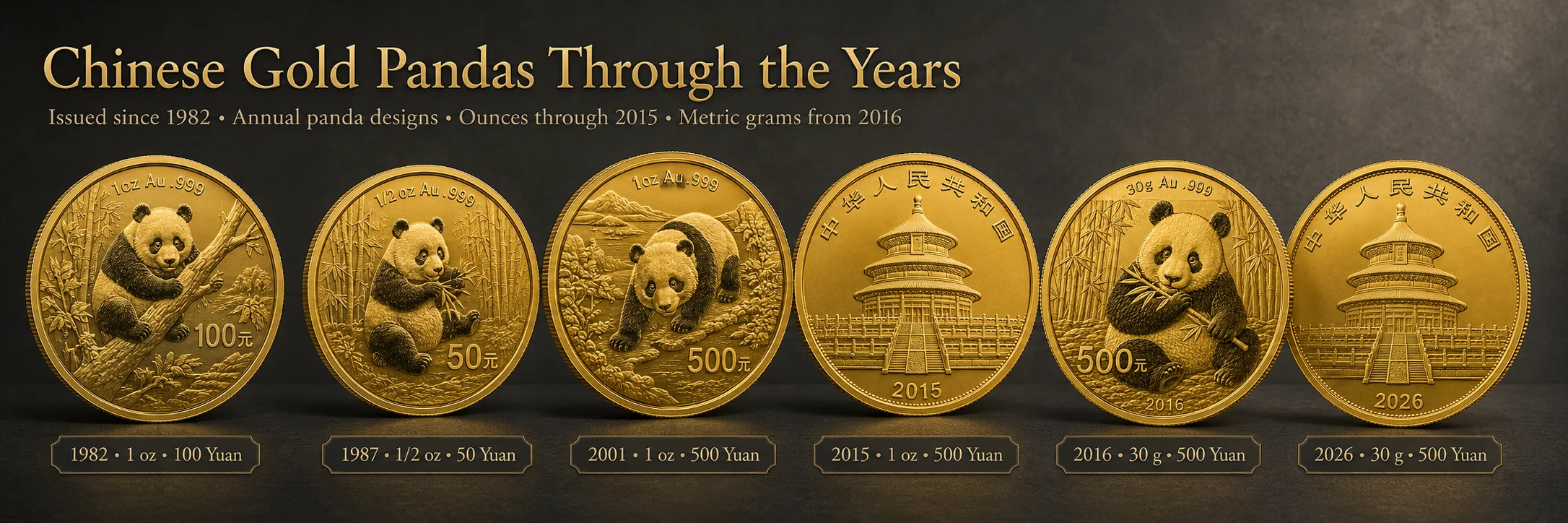
The Temple of Heaven is a recurring element of the series, while the panda side has showcased the animal in a remarkable variety of poses and settings. Over the decades, collectors have encountered individual pandas, pairs, mothers with cubs, pandas eating bamboo, climbing, resting and playing.
A group of Gold Pandas from different years therefore provides something that a stack of many conventional bullion coins does not: a visual chronology of the series.
There is one famous exception to the changing-design tradition. The 2002 Panda repeated the 2001 panda design. That experiment was short-lived, and subsequent issues returned to changing panda artwork.
A Gold Panda does not have to be evaluated only as a quantity of gold. The year itself may identify a different design, denomination, mintage, variety or collector market.
2015–2016: A Major Turning Point
One of the most important changes in the history of the Gold Panda occurred over the 2015 and 2016 issues.
2015 — The Transitional Year
In 2015, Panda coins retained their denominations but the traditional weight and fineness inscriptions were removed from the coin designs.
The gold content itself did not suddenly disappear. A 2015 one-ounce Gold Panda still contained one troy ounce of .999 fine gold. The distinction was that the weight and purity were no longer stated on the coin.
That makes 2015 an especially interesting transitional issue between the traditional ounce-based Panda series and what came next.
2016 — The Panda Goes Metric
Beginning in 2016, the standard Panda bullion program changed from traditional fractional-troy-ounce weights to metric gram weights.
| Traditional Size Through 2015 | Metric Size Beginning 2016 |
|---|---|
| 1 oz | 30 grams |
| 1/2 oz | 15 grams |
| 1/4 oz | 8 grams |
| 1/10 oz | 3 grams |
| 1/20 oz | 1 gram |
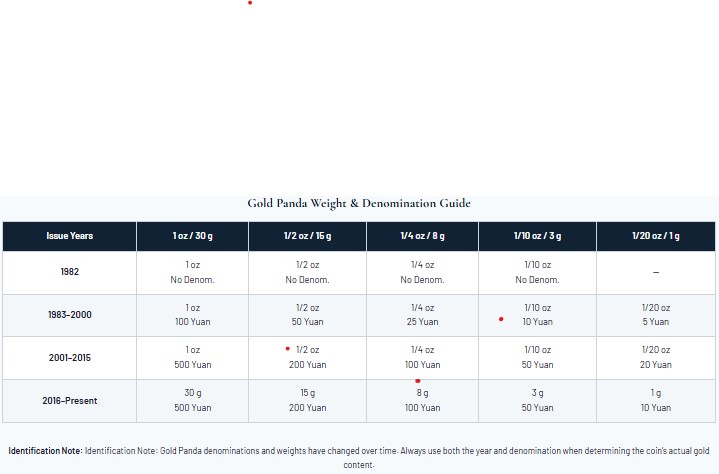
The difference is important. A 30-gram Panda is not simply a one-ounce Panda with a different label. One troy ounce equals approximately 31.1035 grams, while the modern large standard Panda contains 30 grams of gold.
Likewise, the old quarter-ounce Panda contained approximately 7.776 grams of gold, while the metric-era replacement contains 8 grams.
2014 — Traditional ounce-based markings
2015 — Weight and fineness omitted from the design
2016 — Metric Panda series begins
.999 Fine Gold — But Not All Pandas Are Equal
Standard Gold Pandas have historically been struck in .999 fine gold.
From the bullion investor’s perspective, that makes them a convenient form of highly pure physical gold.
From a collector’s perspective, however, identical purity does not mean identical market value.
Two Pandas containing the same amount of gold may trade at very different premiums because of differences in:
- Year of issue
- Original mintage
- Surviving population
- Design
- Variety
- Condition
- Original packaging
- Third-party certification
- Collector demand
Gold content establishes an important underlying value. It does not necessarily establish the entire value of a collectible Panda.
Mintage Is Important — Availability Can Be More Important
Published mintage figures provide an important starting point when evaluating a Panda, but mintage alone does not tell the entire story.
A coin struck decades ago may have been:
- melted for its gold content,
- used in jewelry,
- handled or damaged,
- improperly stored,
- separated from its original packaging,
- lost from the active collector market, or
- distributed into geographic markets where supply remains limited.
This creates an important distinction between original mintage and the number of attractive coins actually available to buyers today.
A relatively modest mintage can certainly contribute to scarcity, but actual market availability and collector demand ultimately determine how difficult a particular Panda is to acquire.
Original Plastic, Sealed Coins and “No Plastic” Pandas
Earlier Gold Pandas are frequently encountered in original mint packaging or soft plastic pouches.
That is why RPMEX may distinguish between products described as:
In Original Plastic vs. No Plastic
The contained gold does not change simply because the plastic has been removed, but original packaging may be of interest to collectors and can provide evidence that a coin has avoided certain types of handling.
There is an important caveat: original packaging should not automatically be assumed to be ideal for permanent preservation. Numismatic references have documented the use of soft plastic packaging on earlier Chinese coins and the possibility of PVC-related effects on coins left in some packaging for extended periods.
Consequently, original packaging and actual coin condition should be evaluated separately.
Condition: When a Bullion Coin Becomes a Collector Coin
Two Gold Pandas of the same date and weight can have identical gold content yet present very differently after decades of ownership.
Collectors may pay attention to:
- contact marks,
- scratches or hairlines,
- rub or friction,
- spots or discoloration,
- haze,
- fingerprints,
- disturbed surfaces,
- evidence of mounting or jewelry use, and
- overall eye appeal.
A bullion-oriented buyer may consider some of these factors secondary when the primary objective is obtaining physical gold.
A collector paying a substantial premium for a scarce date, variety or superior example may view the same issues very differently.
It is also: “Am I buying this particular Panda primarily for its gold content, or for its numismatic characteristics?”
Certified Chinese Gold Pandas
Chinese Gold Pandas are widely certified by independent third-party grading services such as NGC and PCGS.
Third-party certification can provide several benefits, including:
- authentication,
- a professional opinion of grade,
- standardized encapsulation,
- recognized variety attribution,
- population information, and
- potentially easier comparison between collector coins.
Certification does not automatically make a Panda rare, nor does a high numerical grade guarantee future value.
The better questions are:
- Which year?
- Which weight?
- Which variety?
- Which grade?
- How many have been certified at that level?
- How strong is collector demand?
Third-party grades and designations are the opinions of the respective grading services and are not guarantees of value or future performance.
Varieties: Where Panda Collecting Gets Deeper
A beginning Panda collection can be extremely simple: obtain one coin from each desired year.
Serious Panda collecting can become considerably more detailed.
Specialists have identified differences involving such characteristics as:
- date size and positioning,
- lettering and typography,
- frosted versus mirrored elements,
- Temple of Heaven details,
- panda and bamboo details,
- die characteristics, and
- other production differences.
Some varieties have gained formal recognition from major grading services, providing an entirely separate level of collecting beyond simply assembling one coin from every year.
In that respect, the Panda series is unusual: a buyer can approach it as uncomplicated gold bullion or pursue it at an advanced numismatic level.
Fractional Gold Pandas
Fractional sizes have always been one of the strengths of the Gold Panda program.
During the traditional ounce era, buyers could choose among sizes including:
- 1 ounce
- 1/2 ounce
- 1/4 ounce
- 1/10 ounce
- 1/20 ounce
The modern metric family provides similarly broad flexibility:
- 30 grams
- 15 grams
- 8 grams
- 3 grams
- 1 gram
Fractional gold can provide a lower dollar entry point, easier incremental accumulation and greater flexibility when selling individual pieces.
The tradeoff is familiar to experienced precious-metal buyers: smaller gold units often command higher acquisition premiums per ounce of contained gold than larger units.
Pandas add another dimension because a particular fractional date can also develop collector demand beyond its ordinary bullion premium.
Large-Format Gold Pandas
The five familiar bullion sizes represent only part of the Gold Panda story.
China has also produced much larger Gold Panda issues, including multi-ounce and kilogram-format coins and commemorative pieces.
These large-format Pandas occupy a very different segment of the market. Their value may reflect:
Gold Content + Limited Production + Design + Condition + Specialist Demand
As with many modern collector coins, relatively limited production does not by itself guarantee appreciation, but the combination of substantial gold content and limited availability makes the large Panda issues a distinct area of specialization.
Bullion Value vs. Numismatic Value
This is perhaps the most important distinction for a buyer evaluating Chinese Gold Pandas.
Bullion Value
Bullion-oriented value is driven primarily by:
Contained Gold × Current Gold Market Price
plus the prevailing market premium for that particular product.
Numismatic Value
Collector value can additionally reflect:
- year,
- mintage,
- scarcity,
- variety,
- condition,
- certification,
- population, and
- collector demand.
A common-date Panda in ordinary condition may trade primarily as bullion.
A scarce date, important variety or exceptional certified example may trade very differently despite containing the same quantity of gold.
Neither approach is inherently better.
The important thing is to understand what you are paying for.
Ways to Build a Chinese Gold Panda Collection
One reason the Gold Panda series remains so interesting is that there is no single correct way to collect it.
One Coin From Every Year
Perhaps the most intuitive approach. The changing annual panda artwork makes a date collection visually interesting in a way that many bullion date sets are not.
Collect a Single Weight
A buyer may specialize in one-ounce Pandas through 2015, 30-gram Pandas beginning in 2016, or one of the fractional sizes.
Build a Fractional Panda Set
Fractional coins can provide a more accessible way to develop a substantial date collection while still accumulating physical gold.
Original-Packaging Collection
Some collectors specifically seek earlier examples that remain in their original mint packaging.
Certified Panda Collection
Other buyers focus on NGC- or PCGS-certified examples at a selected minimum grade.
Variety Collection
Advanced collectors may pursue recognized die and design varieties in addition to completing the basic dates.
Bullion Accumulation
A buyer who is primarily interested in ounces or grams of physical gold may simply purchase whichever Gold Panda offers the most attractive combination of price, size and liquidity at the time.
A Short Chinese Gold Panda Timeline
1982
Chinese Gold Panda series debuts with four principal gold
sizes.
1983
The 1/20-ounce fractional Gold Panda joins the series.
1980s and Beyond
The Panda program expands to include additional
collector-oriented and large-format gold issues.
2002
The panda design essentially repeats the 2001 design,
making 2002 the notable exception to the series’
changing-design tradition.
2003
The changing annual panda-design tradition continues.
2015
Weight, fineness and metal inscriptions are omitted from
the Panda design, creating a distinctive transitional year.
2016
The standard Panda bullion program moves from traditional
troy-ounce weights to 30g, 15g, 8g, 3g and 1g metric
weights.
Why Chinese Gold Pandas Remain Popular
Gold Pandas occupy an unusual place in the physical precious-metals market.
They combine:
- Highly pure physical gold — standard Gold Pandas are .999 fine.
- Sovereign coinage — produced as part of China’s national Panda coin program.
- Changing designs — creating visual interest from year to year.
- Fractional flexibility — allowing buyers to choose among multiple gold weights.
- A long-running series — beginning in 1982 and continuing through multiple generations of collectors.
- Collector depth — dates, varieties, packaging and certification provide levels of specialization well beyond ordinary bullion.
“How much gold do you want?”
The Chinese Gold Panda adds another question:
“Which Panda do you want?”
Buying Chinese Gold Pandas
When considering a Chinese Gold Panda, it can be useful to look beyond the advertised price and evaluate what is actually being offered.
Consider:
- actual precious-metal content,
- year of issue,
- denomination,
- original packaging,
- overall condition,
- certification when applicable,
- known scarcity or varieties, and
- the premium compared with alternative forms of gold.
A buyer whose primary objective is gold accumulation may place greater emphasis on contained gold and acquisition premium.
A buyer whose objective is collecting may reasonably place more weight on date, variety, packaging, grade and relative availability.
Understanding that distinction before buying can help prevent paying a collectible premium for a coin when the actual goal is simply to accumulate gold — or overlooking the numismatic characteristics of a Panda that deserves to be evaluated as more than bullion.
Shop Chinese Gold Pandas at RPMEX
Explore current RPMEX Chinese Gold Panda offerings, including traditional ounce-based coins, metric issues, fractional Pandas and other available dates and sizes.
This material is provided for educational and informational purposes. Precious-metal prices, premiums, availability and numismatic markets change over time. References to mintages, grades, populations, scarcity or historical market behavior should not be interpreted as guarantees of present or future value. Grades and designations assigned by third-party grading services are the opinions of those services.
Additional Panda Research
For collectors who would like to research individual dates, varieties, mintages and certified populations in greater detail, useful independent references include: NGC Chinese Gold Panda Price Guide and PCGS Chinese Gold Panda Price Guide .